REVIEW · AGADIR
Discovery of the Souss Massa Animal Park in 4×4
Book on Viator →Operated by Agadir Visite · Bookable on Viator
Endangered animals and ocean villages, in one long day. This 4×4 outing from Agadir mixes Souss Massa wildlife with real coastal stops along Morocco’s wild Atlantic edge, from fishing villages to cliffside homes. You get the comfort of private transport, plus time to see rare species up close in a pre-Saharan setting.
I love how the day puts the spotlight on endangered desert animals like Addax and Dama gazelles, plus other park residents such as Oryx and the red-necked ostrich. I also like the way the route slows down for people and place: Tifnit’s fishing village vibe, then troglodyte shelters at Sidi R’bat where a tea break feels natural, not forced.
One drawback to plan for: it’s a long day, roughly 8 to 10 hours, with a chunk of driving on rougher tracks, and lunch isn’t included. If you’re the type who gets cranky after a long morning, bring snacks and water.
In This Review
- Key things that make this 4×4 Souss Massa day special
- A 4×4 day trip from Agadir that mixes desert and the Atlantic
- Entering Souss Massa Animal Park: Addax and Dama gazelle conservation up close
- Addax: the vanishing antelope story
- Dama gazelle: speed, rarity, and the threat of poaching
- Other park residents you may spot
- Tifnit fishing village: beach walking and small boats on Morocco’s Atlantic edge
- Sidi R’bat troglodyte houses: cliffside homes for working fishermen
- Massa and the bald ibis: a bird you won’t forget
- Barrage Youssef Ibn Tachfine: 300 million cubic meters in the desert
- Tiznit city time: silver jewelry and medina walls
- Price and value: what $121.95 per person buys you
- What to expect from the guide and pace
- Practical tips so you enjoy every stop
- Should you book this 4×4 Souss Massa Animal Park tour?
- FAQ
- How long is the Souss Massa animal park 4×4 excursion?
- Where does the tour start and end?
- What is included in the ticket price?
- What time does the tour begin?
- Does the tour visit the fishing village of Tifnit and Sidi R’bat?
- Are there admission tickets included for the wildlife areas?
- What is the cancellation policy?
Key things that make this 4×4 Souss Massa day special
- Up-close views of endangered species: Addax, Dama gazelles, and more in Souss Massa’s protected zone
- A wildlife stop that teaches something real: from extinction history to why conservation matters
- Coastal stops that feel lived-in: Tifnit fishing boats, then Sidi R’bat’s cliffside troglodyte homes
- Sand-track driving along the Atlantic: around 20 km on a wild shoreline stretch
- Bird country with the bald ibis focus: a conservation story tied to Europe, Turkey, and Morocco
- A practical city finish in Tiznit: silver jewelry workshop option and time near the medina walls
A 4×4 day trip from Agadir that mixes desert and the Atlantic
This is the kind of excursion that breaks up the usual “park, photo, back to the bus” pattern. You start in the Agadir area early (start time is 8:30 am), then head away from the city into the Souss Massa region. The 4×4 part matters because it gets you to places where the scenery changes fast and the pace stays more adventurous.
It’s also set up as a private outing, so it’s just your group in the vehicle. That helps when you want to ask questions, move at a comfortable speed, or spend an extra minute at a viewpoint. It’s priced at $121.95 per person, and for the route you’re covering, the value comes from combining wildlife plus cultural coastal stops.
If pickup is available for your booking, it’s worth confirming timing upfront. Otherwise, you’ll meet at the Agadir Visite office area in the Balnéaire sector (TIVOLI complex, Bloc C, Boulevard du 20 Aout).
Entering Souss Massa Animal Park: Addax and Dama gazelle conservation up close
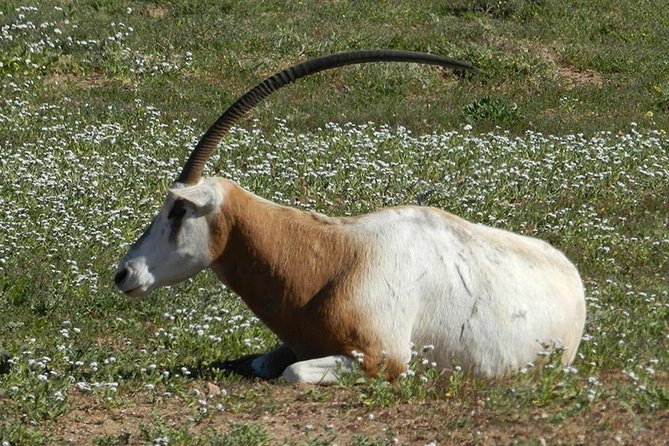
The heart of the day is your time in the National Park of Souss Massa, where you focus on species tied to the pre-Saharan ecosystem. Plan for about 2 hours at this first wildlife stop, with park admission included.
Addax: the vanishing antelope story
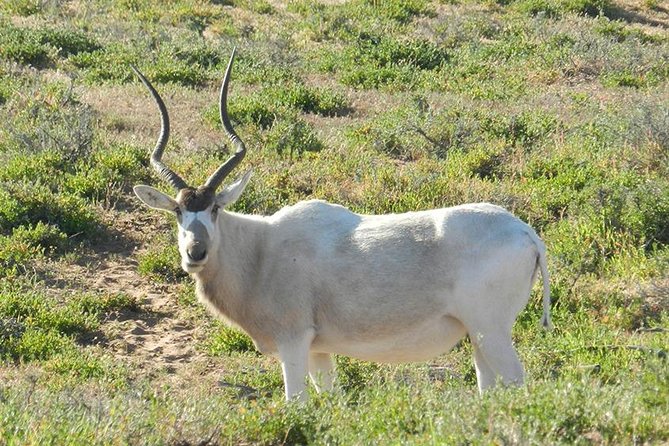
You’ll see the Addax, an antelope adapted to sandy desert life. What makes it fascinating is the way it moves: Addax live in groups and make long migratory movements following pastures that appear only when rainfall triggers new growth. That means their survival depends on timing and chance.
Here’s the sobering part you’ll learn: wild Addax populations are very small and scattered in the southern Sahara. In Morocco, the species disappeared in 1956 due to poaching and intensive hunting. The Addax is classified as in danger of extinction, which helps explain why these protected areas are such a big deal.
If you’re a detail person, the park info shares size ranges too: around 110 to 130 cm in length, roughly 95 to 115 cm in height, and a weight range about 60 to 125 kg. Those numbers help you calibrate your expectations when you’re looking at animals in person.
Dama gazelle: speed, rarity, and the threat of poaching
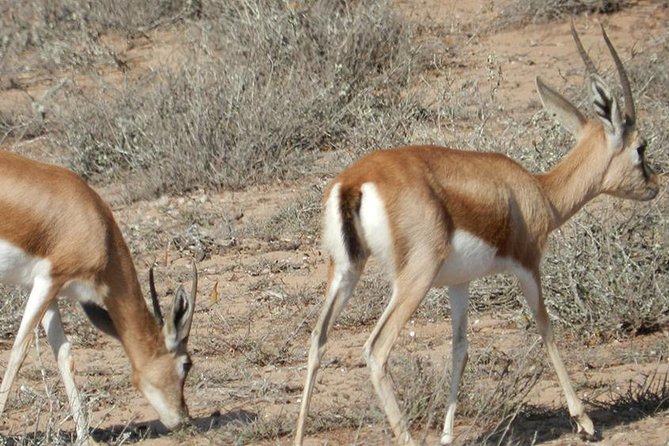
Next up is the Dama gazelle, the largest gazelle and also one of the fastest. You’ll be told it can exceed 100 km/h at peak speed, and that it’s fierce in how it runs, fleeing over long distances.
Dama gazelles are rare and localized south of the Sahara. The threats are similar to Addax: poaching pressures and population decline across suitable habitats. Like the Addax, it’s also classified as in danger of extinction.
For me, this is the best kind of animal-park visit: not just “look and move on,” but “learn what you’re looking at and why it matters.”
Other park residents you may spot
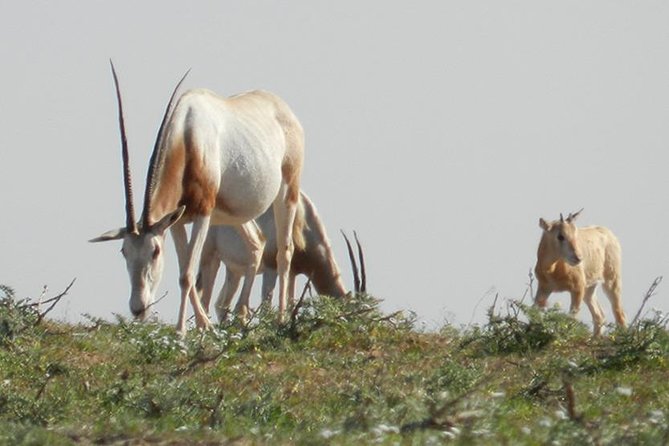
The broader park focus includes species mentioned for this excursion such as Oryx antelopes and the red-necked ostrich. You won’t just be staring at one species the whole time, which keeps the visit from feeling one-note.
Tifnit fishing village: beach walking and small boats on Morocco’s Atlantic edge
After Souss Massa, the day pivots toward the coast. You reach the road to Tifnit, a fishing village, where you get a photo pause and a short beach hike. Expect around 15 minutes here.
This isn’t a “tour of fishing” with scripted steps. It’s more like you’re arriving and seeing the place as it is: small motor boats, the everyday rhythm of coastal life, and that feeling of being near the ocean without the crowds you might get closer to larger tourist zones.
If you want to make this stop work for you, bring your phone camera patience. The shoreline and boats give you plenty of angles, but the best photos come when you slow down for a minute instead of rushing past.
Sidi R’bat troglodyte houses: cliffside homes for working fishermen
Then you move along a sand track for about 20 km over roughly 2 hours along the wild Atlantic coast. That drive time isn’t just “getting there.” It sets the tone. It feels more like a route than a transfer.
At Sidi R’bat, you’ll stop at troglodyte houses—homes dug into the cliff facing the ocean. These aren’t historic decoration pieces. They work as shelters for fishermen who stay for a few days by the water.
The routine is simple and practical: fishermen keep their equipment and belongings close, fish, then leave once a week to visit family in the farther village. The result is an intimate kind of architecture—built for work, not presentation.
You’ll also have time for a tea break here (about 30 minutes). That’s one of those small moments that often becomes the memory. It also helps you warm up after the cooler ocean air, especially if you’re visiting in seasons when mornings or late afternoons feel brisk.
Massa and the bald ibis: a bird you won’t forget
Your next nature-focused stop is the mouth of Oued Massa and Souss Massa National Park, with about 30 minutes on site. This is where the outing adds a strong conservation angle through the bald ibis.
The bald ibis is described as one of the most endangered bird species in the world and a species classified as in danger of extinction. The story is wide-ranging and a little surprising. Historically, bald ibises were found across the Mediterranean basin, and they were even linked to Egypt in ancient symbolism. They were also present in Europe, with nesting reported in the Alps in the 16th century.
Then the numbers fell. Causes include hunting, agricultural development, and widespread pesticide use. The last colony in Europe’s old range disappeared in Turkey in the 1970s. In Morocco, the account shares that 40 colonies were known in the early 20th century, and today only 4 breeding colonies are listed in the kingdom.
Why this matters for your visit is simple: seeing the animals is exciting, but understanding the pressures behind them makes your photos feel more grounded. It turns a roadside sighting into a story you can actually explain afterward.
Barrage Youssef Ibn Tachfine: 300 million cubic meters in the desert
Next is a photo stop at Barrage Youssef Ibn Tachfine (also spelled Youssef Ben Tachefine). You get around 20 minutes, taken at the highest point of the rock so you can admire the dam and the lake.
The detail you’ll likely hear is big-scale: the lake capacity is about 300 million cubic meters. Even if you’re not a hydrology nerd, it helps you picture how water management reshapes desert spaces.
This stop also breaks the day into sections. After wildlife and coastline, the dam view gives you a wider, calmer moment—good for photos, good for a breath, and good for resetting your eyes.
Tiznit city time: silver jewelry and medina walls
By the time you reach Tiznit, you’re close to the end of the day, with about 30 minutes scheduled. Tiznit is located around 100 km south of Agadir. It’s known for a ring of ramparts roughly 6 km long, and for its silver jewelry craftsmanship.
You may get an optional step at a silver jewelry factory. This is a nice choice if you like seeing hands-on work rather than just shopping. You’ll also have a small tour of the walls and the interior of the medina by car.
This is not a full medina immersion. It’s more of a quick introduction. But it’s a smart finish because it adds culture to the wildlife-heavy first half of the day, and it keeps the outing from feeling like one long nature loop.
Price and value: what $121.95 per person buys you
At $121.95 per person for a roughly 8 to 10 hour private 4×4 day, the value comes from three things working together.
First, you get private transportation for the whole route. That matters because your itinerary isn’t just a straight line. You’re bouncing between protected areas, fishing-coast stops, and a city finish.
Second, admission fees to Souss Massa National Park are included. That reduces the hidden add-ons that can creep into “day tour” pricing.
Third, you’re getting multiple “types” of stops: wildlife (with conservation context), coastal culture (Tifnit and Sidi R’bat), bird country (bald ibis), and a dam viewpoint plus Tiznit’s craftsmanship.
The main thing to watch is the missing lunch. Since lunch isn’t included, you’ll want to plan your own food strategy. Even if your guide keeps things moving smoothly, you don’t want to gamble on finding something fast when the schedule is tight.
What to expect from the guide and pace
This outing tends to be driven by guides connected with Agadir Visite, and names that come up are Hamid and Abdou. Several people also describe the experience with the same theme: the guide explains what you’re seeing and adjusts to your interests and timing.
In practical terms, that means you’re not stuck with a rigid script. If your group is more into animal behavior, you’ll likely get more time on that. If you care more about the fishing villages and troglodyte homes, the guide can focus the narrative that way.
It’s also worth noting that the vehicles are described as comfortable, which helps when you’re doing a long day and dealing with sand-track stretches.
Practical tips so you enjoy every stop
A few small things will make a big difference:
- Bring water and a snack. Lunch isn’t included, and the day is long.
- Wear shoes that handle sand and occasional uneven ground.
- Expect sun and glare, even when the coast has cooler air. A hat helps.
- If you want souvenir shopping in Tiznit, keep some small cash handy for factory options, since that part is described as optional.
Should you book this 4×4 Souss Massa Animal Park tour?
I’d book it if you want a day that feels like southern Morocco, not just a checklist. The wildlife component is strong because it focuses on endangered species with actual conservation context: Addax, Dama gazelles, and the bald ibis story. Then the route earns its keep with meaningful coastal stops in Tifnit and Sidi R’bat, including that tea break in cliffside troglodyte homes.
Skip it if you hate long drive days or you need a guaranteed sit-down lunch. Also, if your ideal vacation is purely “one place, slow pace,” this schedule may feel like too much movement.
If you can handle a full day and you like learning while you look, this is a very solid value choice for an Agadir base.
FAQ
How long is the Souss Massa animal park 4×4 excursion?
The duration is listed as approximately 8 to 10 hours.
Where does the tour start and end?
It starts at the Agadir Visite meeting point in Agadir (Boulevard du 20 Aout, TIVOLI complex, Bloc C, Secteur Balnéaire) and ends back at the same meeting point.
What is included in the ticket price?
Private transportation is included, and entrance fees to Souss Massa National Park are included. Lunch is not included.
What time does the tour begin?
The start time is 8:30 am.
Does the tour visit the fishing village of Tifnit and Sidi R’bat?
Yes. You stop in Tifnit for a photo stop and a short beach hike, then you continue to Sidi R’bat for a visit to the troglodyte houses.
Are there admission tickets included for the wildlife areas?
Admission fees to Souss Massa National Park are included, and the other listed stops (like Tifnit, Sidi R’bat, Massa, Barrage Youssef Ibn Tachfine, and Tiznit) are described as free with admission ticket free.
What is the cancellation policy?
Free cancellation is offered up to 24 hours in advance for a full refund. If you cancel less than 24 hours before the start time, the amount paid is not refunded.